Erica
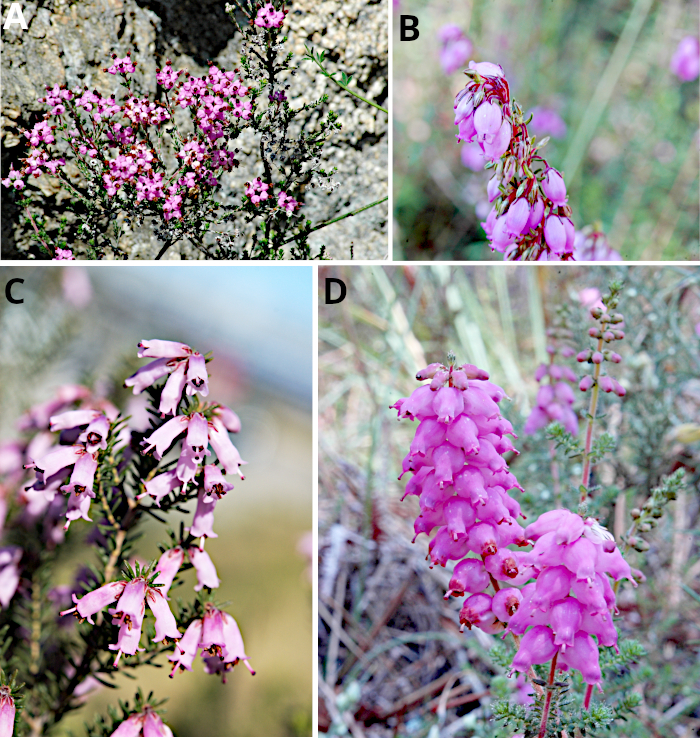
Erica includes around 865 species, commonly referred to as heathers. It is among the plant genera that has the highest number of species. They are small bushes meassuring 20 to 150 cm in heigth (Figure 1; only a few species may exceed 1 meter tall). They are perennial plants.
Stem
Leaf
The leaves are perennial, very small, and distributed in whrols containing 3 to 6 leaves.They usually show revolute margins (curled toward the lower surface), so much that some species hide the lower surface (abaxial). This not-much exoposed, or hidden, lower surface show trichomes and white color. These leaves are generally not wide with short petioles
The leaf density reduce the water loss.
Flower
Flowers are actinomorphic, forming umbeliform, racemiform, or paniculiform inflorescences. They contain 4 sepals and 4 petals. The corolla is tube- or bell-shaped and is quite persistent. The European species are characterized by having bell-shaped corollas, while Africans show a wider range of morphologies. There are 8 stamens. The ovary is superior, with four loculi, or chambers, situated over a nectariferous lobed disc.
Many species of Erica in the Cape area have sticky petals, which is not a very common trait. The substance that makes them sticky is resin or mucin released by glandular trichomes or other types of glands in plants lacking trichomes. It has been proposed that this feature aims to hinder the activity of insects that steal nectar or to repel herbivores. It has been found that those Erica species pollinated by birds or insects with long proboscises show more sticky corollas, avoiding the nectar robbing by other animals. In addition, the sticky compounds enhances the corolla integrity. The flowering period of Erica is usually long.
Up to 38% of Erica in South Africa show color polymorphism. It means that individuals of the same species display different colors. Color polymorphism is relatively rare in the plant kingdom. In Erica, as many as five colors can be found within the same region, even if each population mostly expresses a dominant color. Colors have meaning because they do not appear randomly. For instance, entomophilous species (pollinated by insects) show pink, purple, and white colors along with shorter corollas, while ornithophilous species (those pollinated by birds) show red, orange, yellow, and green colors with larger corollas.
The main factors favoring a higher color polymorphism in Erica in South Africa include a wide altitude range distribution (resulting in more variety of colors), a limited distribution at very low altitudes (at the level of the coastline), long flowering periods, autumn flowering, and pollination by birds.
There is no polyploidy in Erica. All species studied so far display 12 chromsomes, excluding Erica spiculifolia with 18 chromosomes.
Fruit, seed
Pollination may be by the wind, insects, or birds. Fruits are small capsules, typically dry and hard. Only a small number of species show fleshy fruits. Seeds are very small, usually smaller than 1 mm.
Root
Habitat, distribution
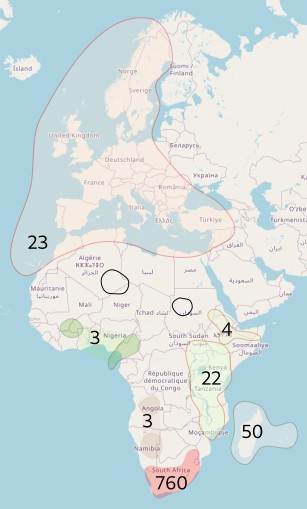
Most species of Erica are found in the Cape floristic region of South Africa, where about 700 species out of the 865 species of Erica being present there; most are endemic. There is such a high density and variety of species that it is difficult to understand how to prevent hybridization processes. They are also distributed across different areas in African, from Ethiopia to Madagascar. Some species are found in Australia, New Zealand, and the Himalayas. There are around 20 species in Eastern Europe and North Africa. In Europe, they live in soils with few nutrients and can populate acid soils.
Society
Traditional medicine has been using species of the Erica genus due to their diuretic, anti-inflammatory, antihypertensive, anti-oxidant, anti-cancer, and anti-microbial benefits. These plants contain flavonoids, tannins, terpenoids, and phenolic acids that are utilized in medicine. They have also been used as plants in gardens.
Phylogeny
Taxonomy NBCI (↗): Viridiplantae > Streptophyta > Streptophytina > Embryophyta > Tracheophyta > Euphyllophyta > Spermatophyta > Magnoliopsida > Mesangiospermae > eudicotyledons > Gunneridae > Pentapetalae > asterids > Ericales > Ericaceae > Ericoideae > Ericeae.
WFO (↗): Plantae > Pteridobiotina > Angiosperms > Ericales > Ericaceae > Ericoideae > Erica
BOLDSYSTEMS (↗): Tracheophyta > Magnoliopsida > Ericales > Ericaceae > Ericoideae > Erica
GBIF (↗): Plantae > Tracheophyta > Magnoliopsida > Ericales > Ericaceae
Molecular phylogenetic studies show that African species form a clade (they share a common ancestor), which branches off from the European phylogenetic tree. Therefore, the African species of Erica are descendants of the European ones. Actually, the species found in North Africa do not seem to have come from the Cape area. The great diversity of species in the Cape region (around 680 species) appears to be a recent and fast evolutionary event, probably due to pollinators, environmental features, and climate influence. The floral morphology does not seem to serve as a trait to make phylogenies since similar adaptations arise in various lineages, and therefore it is a convergent process. Convergent mechanisms also appear at work during recurrent fires.
Bibliography
Adu-Amankwaah F, Mpundu HV, Nyambo K, Strauss P, Tapfuma KI, Tshililo N, Badejo MV, Mabasa L, Mavumengwana V, Baatjies L. 2025. Phytochemical and pharmacological review of Erica Genus (L.) Ericaceae plants. Phytomedicine Plus. 5: 100697. DOI:10.1016/j.phyplu.2024.100697.
Castroviejo S, Aedo C, Gómez Campo C, Laínz M, Montserrat P. Morales R, Muñoz Garmendia F, Nieto Feliner G, Rico R, Talavera S, Villar L. Colaboradoras: Navarro C & Fernández Arias M.ª I.; Vol. IV. Cruciferae-Monotropaceae 1993. Flora Ibérica. Madrid : Real Jardín Botánico, C.S.I.C. http://www.floraiberica.org.
McCarren S, Coetzee A, Midgley J. 2021. Corolla stickiness prevents nectar robbing in Erica. Journal of Plant Research. 134: 963-970. DOI: 10.1007/s10265-021-01299-z.
McGuire AF, Kron KA. 2005. Phylogenetic relationships of European and African ericas. International Journal of Plant Sciences. 166: 311-318. DOI: 10.1086/427478.
Oliver EGH, Forshaw N, Oliver IM, Volk F, Schumann AWS, Dorr LJ, Hoekstra RD, Musker SD, Nürk NM, Pirie MD, Rebelo AG. 2024. Genus Erica: An identification aid version 4.00. Phytokeys. 241: 143-154. DOI: 10.3897/phytokeys.241.117604.
Pirie MD, Oliver EGH, Bellstedt DU. 2011. A densely sampled ITS phylogeny of the Cape flagship genus Erica L. suggests numerous shifts in floral macro-morphology. Molecular Phylogenetics and Evolution. 61: 593–601. DOI: 10.1016/j.ympev.2011.06.007.
Rebelo AG, Siegfried WR. 1985. Colour and size of flowers in relation to pollination of Erica species. Oecologia. 65: 584-590. DOI: 10.1007/BF00379677.