
Sedum brevifolium DC
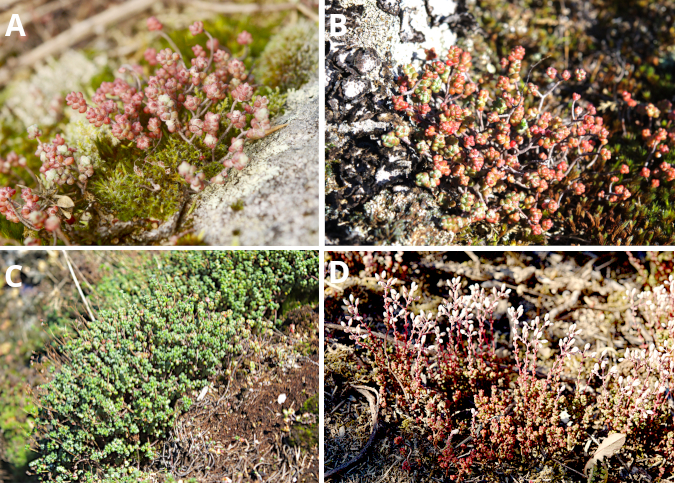
Sedum brevifolium is a species of the Crassulaceae family. The term "brevifolium" means small leaf. It is perennial plant, lacking trichomes (glabrous), displaying a greenish, redish, or brownish color (Figure 1).
Stem
The stems may be non-reproductive, meaning they do not produce flowers, or they can be reproductive. Reproductive stems grow during flowering season and vanish following the reproductive period (Figure 2).
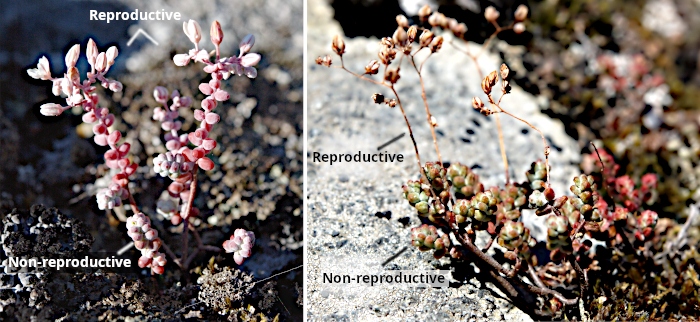
As mentioned previously, reproductive and non-reproductive stems are present in the same plant. However, there are few morphological differences observed between these two kinds of stems. Reproductive stems are larger, with leaves more distant from one another. In the stele (the vascular tissue), reproductive stems show only one ring of sclerenchyma fibers, while non-reproductive stems can show two or more rings in the basal and older parts of the stem (see below).
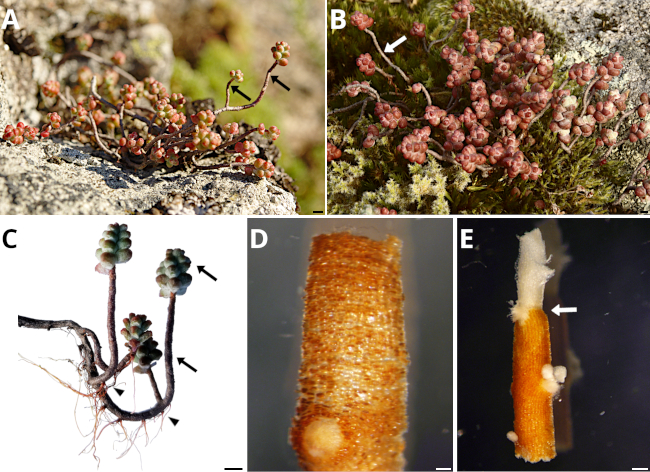
The stem of S. brevifolium is thin and ranges from red-brown to grey, with the upper section displaying a whitish color (Figure 3). The stems may be from 2 to 14 cm long, woody and branched at the base, showing a dense branching pattern.
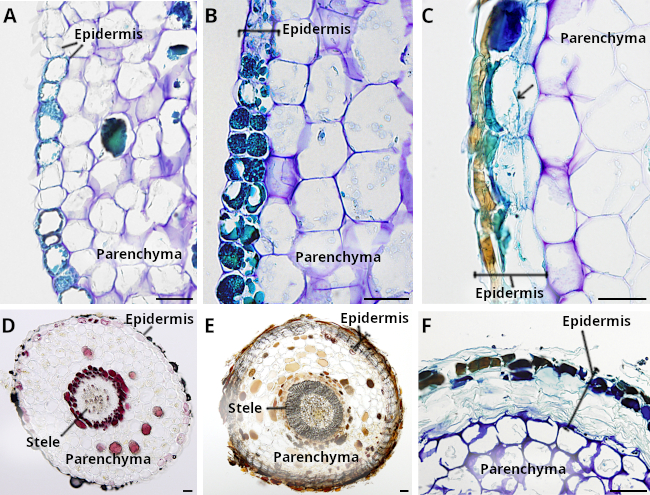
In cross sections, the stem is rounded and divided into four regions: epidermis, cortical parenchyma, stele (vascular tissues), and pith (Figure 4).
Epidermis
The epidermis changes as we move from the apex to lower levels of the stem. It is a single-cell layer of rather flat cells showing a thin cuticle (Figure 5). A few millimeters down, and still covered by the leaves, the epidermis develops into a bilayered structure and then multilayered as we move away from the apex. At the middle and lower levels of the stem, the epidermis may consist of up to 12 layers of cells. At the apical regions, epidermal cells do not contain many pigments in their cytoplasm, leading to a whitish color of the stem (Figure 3E). However, as the number of layers of the epidermis increases, many pigmented cells are visible, although not all cells show this feature (Figure 5F).
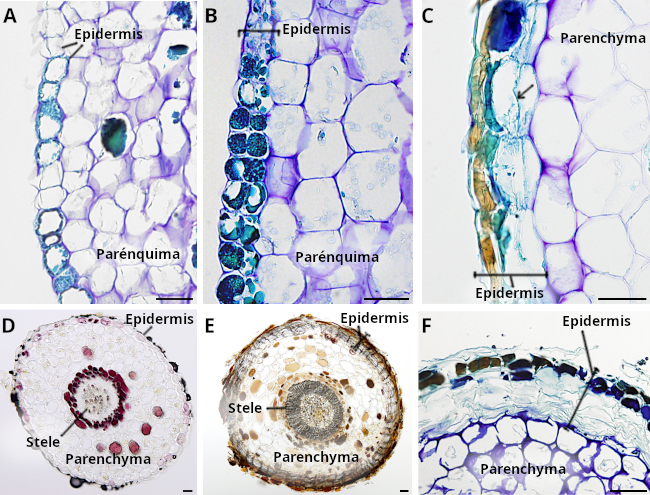
The formation of new cell layers in the epidermis seems to be the result of periclinal divisions of the cells of the basal layer, which are in contact with parenchyma cells (arrow in Figure 5C). This activity is also found in more basal levels of the stem. The epidermal cells forming the basal layer show rather thick basal and lateral cell walls, similar to those of the cortical parenchyma cells. However, the apical cell wall is thinner, and this thickness that is maintained in the cell walls of the upper epidermal layers (Figure 5C; Figure 6).
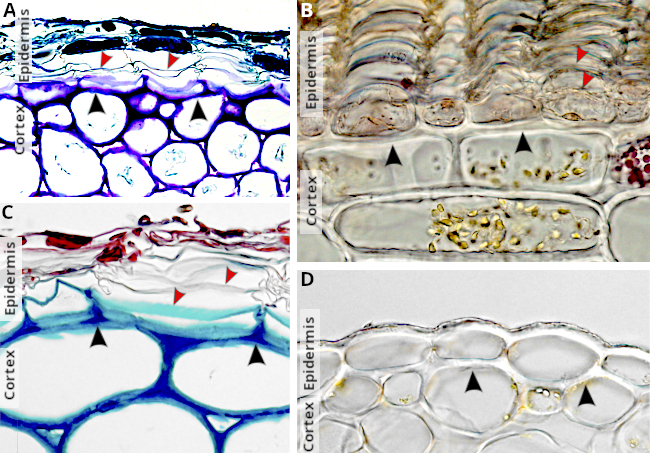
The epidermis does not bear trichomes, the number of stomata is low, and there are few chloroplasts within epidermal cells. However, some cells show many organelles, particularly those forming single or basal ones of bilayered epidermis. The cells or upper layer in the multilayered epidermis were almost devoid of intracellular content. Except for those showing intracellular pigmented material. The outermost layers consist of flat cells, and it remains unclear whether the superficial layer is shed and replaced by a new one or whether they are stable layers.
Leaf
Leaves are densely packaged and overlapped in four rows on the non-reproductive stems, especially near the apex. The leaves are glabrous (no trichomes) and reddish-green hue. They are rounded to ovoid, about 5 mm long and 3 to 5 mm wide. A whitish substance is sometimes observed covering the leaves.
Flower
The flowers form cymose inflorescences with bracts, found at the end of the fertile stems. Flowers are hermaphrodites, with pentamerous organization (5 sepals and 5 petals).The sepals are oval and pointed. Petals are whitish, sometimes pinkish, with a brown stripe in the middle line. Each flower contains about 10 stamens. Sedum brevifolium blooms from May to June.
Fruit, seed
The fruit is a follicle. The seeds are small and show a pear-shaped. The oil content of the seeds is about 13%, with most of the fatty acids that are 18 carbon atoms, and nearly all of wich are unsaturated. The oil content is more related to the longevity of the seed than to its germination or to the weight of the seed itself.
Root
The root is well developed with many slender branches. Adventitious roots are frequent and they emerg from the internodes of the stem. The stem becomes rhizomes as the plant grows.
Habitat and distribution
Sedum brevifolium thrives in siliceous soils, often found on rocky ground with mosses. It grows in sunny places with little substrate, which drains water quickly. It is restricted throughout the Southwest of Europe (Spain, Andorra, Portugal, France, and Italy).
Society
Phylogeny>
Bibliography
Castroviejo S, Velayos M. 1997. Sedum. Flora Ibérica. http://www.floraiberica.org (Consultada en Febrero de 2025).
Espinosa del Alba CE, Mondoni A, Baizán S, Fernández-Pascual E, Jiménez-Alfaro B. 2025. Functional trade-offs and ecological correlates of seed oil traits in alpine ecosystems. Plant biology. DOI: 10.1111/plb.70097.